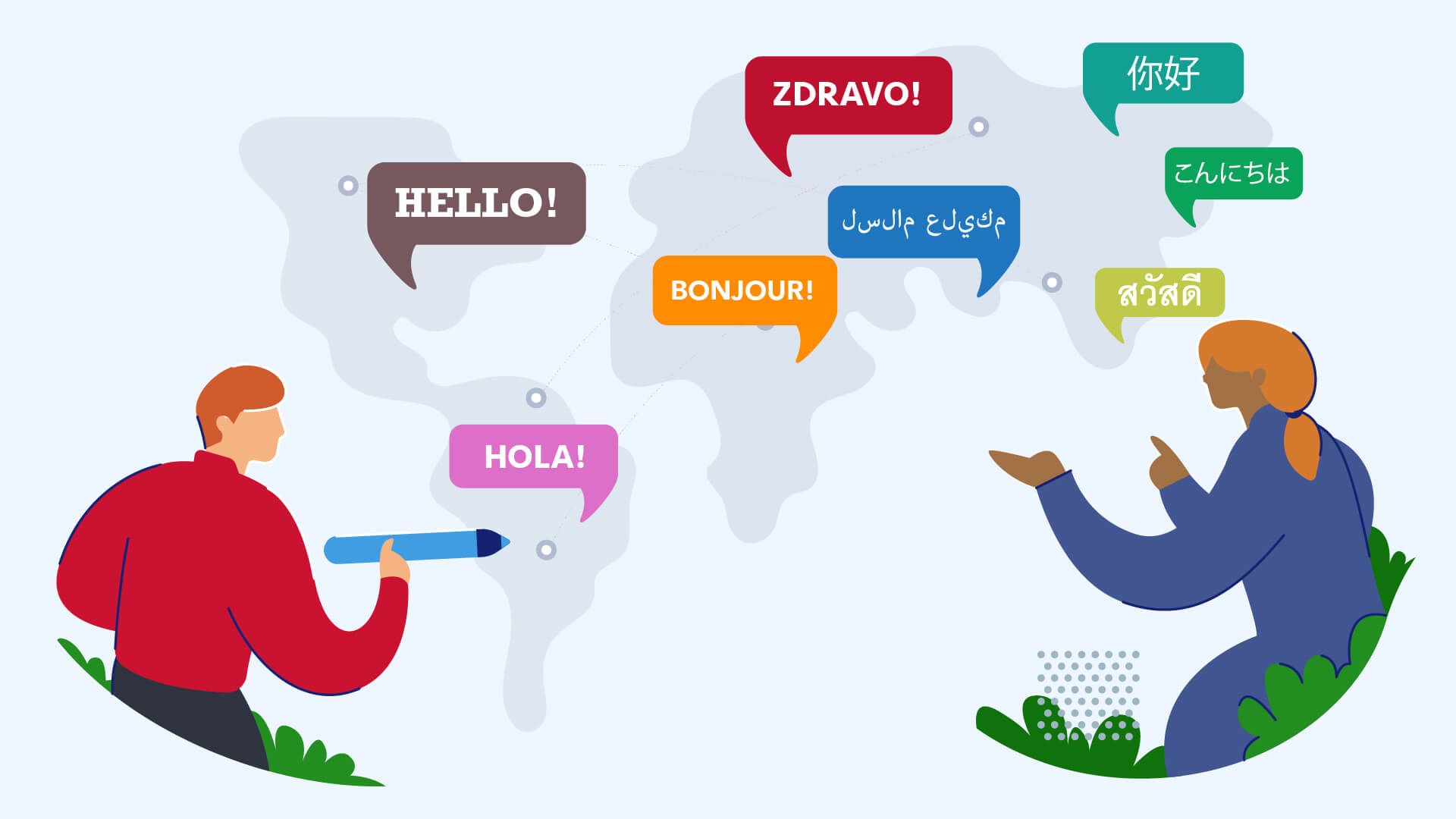
While attending the Massachusetts Nonprofit Network Excellence Awards, we noticed something important: many organizations serve communities where English isn’t the primary language. This got us thinking about how nonprofits can better reach the people they serve—not just donors, but the community members who benefit from their programs and can’t easily access information in English
If your organization serves primarily non-English-speaking communities, how can you effectively communicate your mission and impact through your website?
Why Language Toggle Matters for Nonprofit Mission Alignment
Your nonprofit’s mission exists to serve a specific community. But here’s the uncomfortable truth: if that community can’t understand your website, your mission remains unfulfilled—no matter how thoughtful your programs are.
Many nonprofits experience mission drift without realizing it. You design programs, create impact, and measure outcomes—all in English. Meanwhile, the very people you’re trying to serve are navigating your website in confusion, missing critical information about eligibility, deadlines, or how to access help. This isn’t just a communication problem; it’s an accountability problem. How can you authentically measure impact when a significant portion of your beneficiary community is effectively invisible in your data?
Language accessibility is a mission alignment issue, not a nice-to-have feature. When you remove language barriers, something shifts: your constituents can finally engage with your organization on equal footing. They understand your programs. They know how to participate. They see themselves reflected in your digital presence. This is how nonprofits close the gap between stated mission and actual community impact.
The data tells this story clearly. Let’s look at what’s happening in Massachusetts and why language-inclusive websites are no longer optional for mission-driven organizations.
Transparency Through Numbers
Immigration growth is woven into American history. America is a melting pot. It has been, and always will be. According to recent census data, Massachusetts experienced dramatic net immigration growth: 1,762 people from 2020–2021 compared to 62,737 from 2023–2024. Among these newcomers, many have limited English proficiency (LEP). To be safe, assume that a significant portion of your immigrant audience will benefit from language options beyond English.
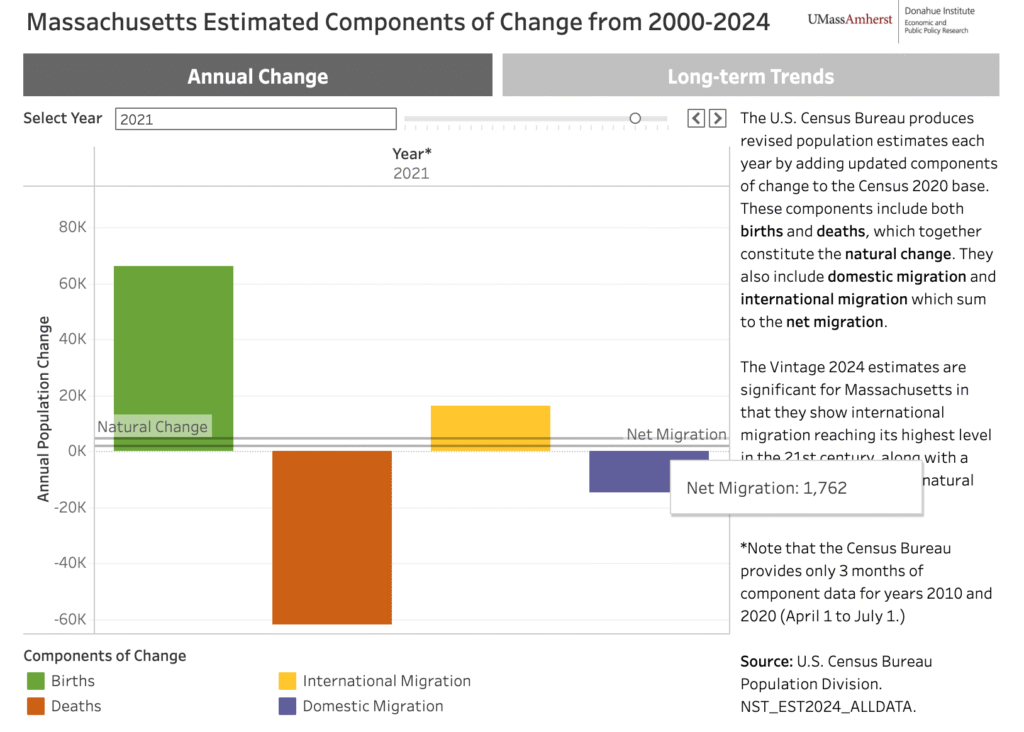
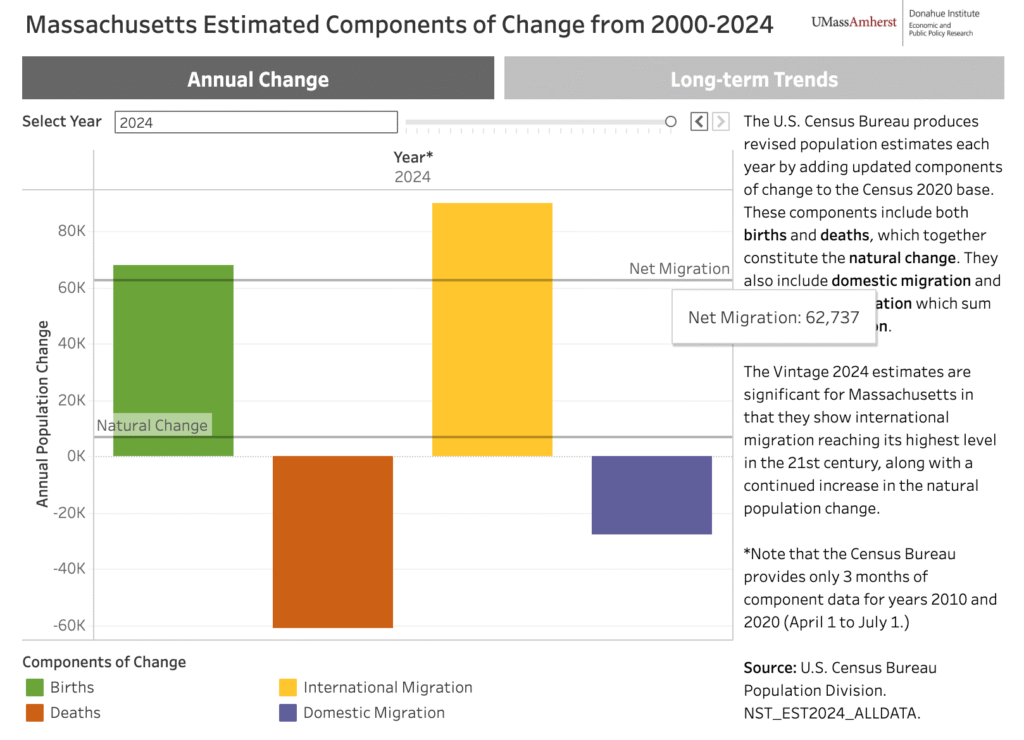
While there is statistical data on population growth within a community, there’s no way to detect the nationality of the viewer who visits your website. If your organization serves immigrant communities, providing content in their preferred languages removes barriers to accessing your services.
Case Study: Quincycles
Quincy, Massachusetts is a coastal city just south of Boston. Key transportation corridors (Quincy Shore Drive, Newport Avenue, and Hancock Street) intersect through the city. This city boasts the largest concentration of Asian Americans out of the entire state. The Asian community in Quincy more than doubled from 2000 to 2020, growing from approximately 13,500 to 31,282 residents. This represents a remarkable transformation in the city’s demographic composition. According to the most recent census, Quincy’s Asian population is approximately 31,282 out of a total city population of 101,636—representing roughly 31% of residents.
Over the past decade, increased bicycle and vehicle traffic has created shared-road challenges, leading to higher accident rates and, tragically, fatalities. The most recent incident occurred in September of 2023, when an 86-year-old cyclist, Wu Li Dain, was fatally struck by a car.
This alarmed the Asian community and an urgent call went out to help notify locals.
Website Project: Quincycles
Quincycles is a local bicycling advocacy group in Quincy, Massachusetts. Their mission is to create a community ride group that plans events, provides education, and advocates for bicycle infrastructure in the city.
When we first spoke with their president, Steve McLaughlin, about the bicycling safety guidelines that they provide, we wanted to know if the Asian community was aware of the information. They were aware of the cycling incidents that occurred in the last decade along with the most recent death. However, their website’s information wasn’t accessible through an alternative language.
Understanding this gap, we proposed redesigning their website to ensure the Asian community could access these critical safety guidelines.
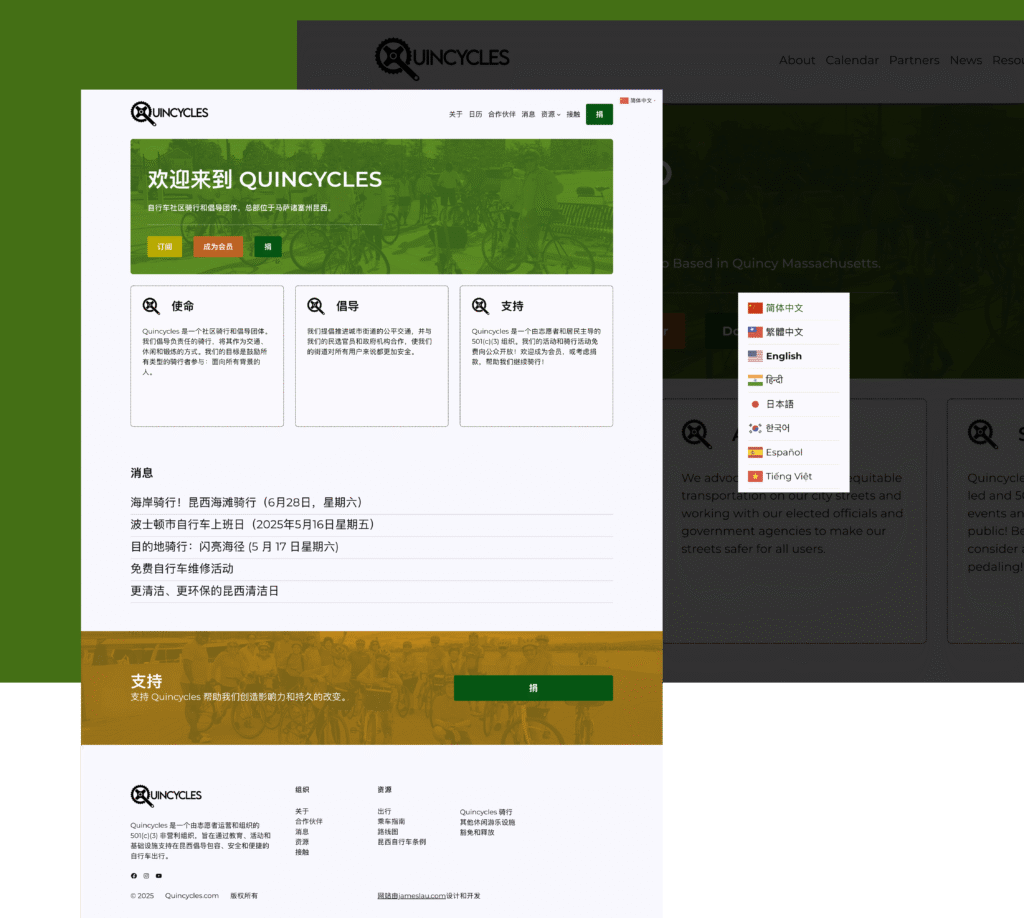
During the wireframe phase, we positioned the language toggle in the header and main navigation—an ideal location that remains visible across all devices. This placement ensures easy access on desktop, tablet, and mobile screens.
Through clear visual cues, users now have full access to content in their preferred language.
Language Toggle Options
Not all website publishing platforms are created equal. Most platforms require downloading language extensions unless the capability is built-in. The first three platforms are open source technology. This means you’re not tied to a proprietary subscription. You can move your content and assets freely between databases and hosting providers.
Open Source Technology
WordPress is by far the most popular and versatile content management system out there. Nearly 40% of all websites out there, run on WordPress. This platform comes barebones once installed, and that is by design. Automattic – the parent company of WordPress – wants you to keep the core system file size small. Add only the features you need from its extensive third-party plugin library. Such popular plugins are: Weglot, WPML, TranslatePress, and GTranslate.
Another popular content management system is Drupal. Though heavier in file size, Drupal includes built-in modules that justify the additional weight. Drupal includes built-in modules (or extensions) preinstalled because they’re used frequently. The tradeoff: additional setup steps are required to activate them.
Our last choice is Joomla. This system has built-in multilingual capabilities, much like Drupal. As of this writing, Joomla 6 has an extensive library of languages to choose from. You need to download and install the specific language(s) needed for your website.
Proprietary Software
Squarespace has been around for well over 15 years now. They are their own system. You’re paying a monthly subscription for cloud-based services. Your hosting, domain name registration, file infrastructure are all managed by their support team. Squarespace uses Weglot for multilingual support, but you’ll need a paid Weglot plan if your website traffic exceeds their free tier threshold.
Webflow, launched in 2013, offers a tier-based localization system. The entry-level plan includes three locales, with additional languages requiring higher-tier pricing. Nonprofits should calculate long-term costs based on their community’s language needs.
Lastly, Wix is a popular proprietary platform for web publishing. You can add multilingual support through their app store, though premium translation features require tiered plans. Review third-party app features and pricing before committing to a monthly subscription.
Conclusion
Language barriers prevent communities from accessing vital information. Everyone deserves equal access to your organization’s content and services. Making information accessible is a fundamental human right—and essential to nonprofit mission alignment.
The organizations we met at the Massachusetts Nonprofit Network Excellence Awards understand something powerful: their mission isn’t just what happens in programs—it’s also how they show up digitally. Quincycles proved this. By adding a language toggle, they transformed their website from a barrier into a bridge. Suddenly, the Asian community in Quincy could access the safety information they desperately needed. The organization’s impact expanded not because their programs changed, but because their digital presence finally reflected their true mission.
Language-inclusive websites aren’t an afterthought. They’re a strategic investment in accountability. When your community can understand your work, you can truly measure impact. When your beneficiaries can navigate your programs independently, you’re honoring both their dignity and your mission.
The technical barriers are gone. WordPress, Drupal, Joomla, Webflow, Squarespace, Wix—every platform offers solutions. The only question left is: which communities will your nonprofit finally reach?
Let’s Build Something Meaningful!
Your community deserves to understand your work. If your nonprofit’s website isn’t reaching the people you serve—whether due to language barriers, outdated design, or unclear messaging—let’s talk about closing that gap.
Reach out at hello@smallactionsstudio.com or write us a message through our contact page to start a conversation about your organization’s digital presence.